The cost of commercial litigation is costing American small businesses a lot, and this problem is structurally identical to what UK businesses face.
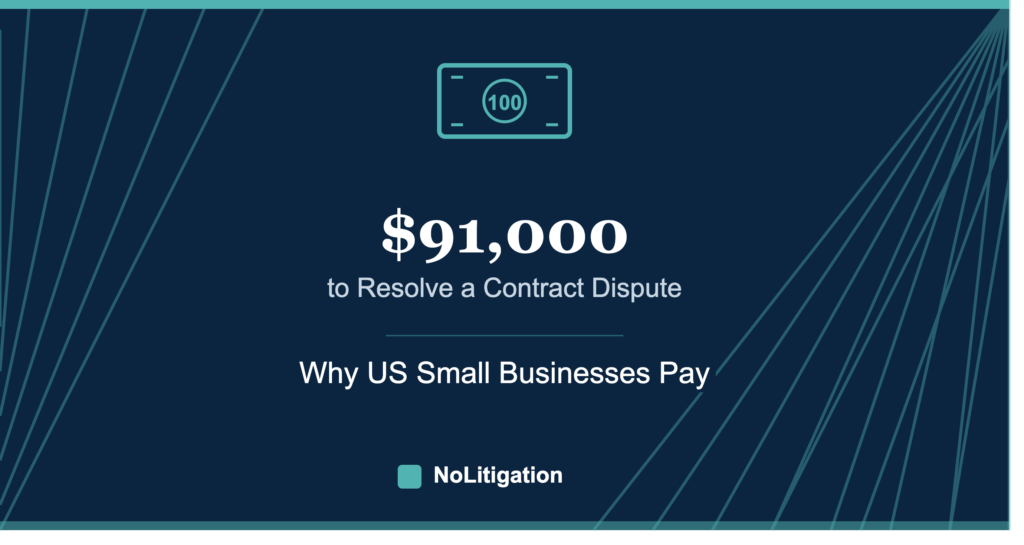
Here is a question every US business owner or startup founder should be asking: if a supplier breaches a $50,000 contract, can you afford to enforce it? For most American small businesses, the honest answer is ‘no’. According to data from RocketLawyer, the median cost for a US small business to resolve a contract dispute through traditional litigation now stands at approximately $91,000.
That figure does not include the months and often years of management distraction, the commercial relationships damaged, and the opportunities foregone while founders sit in depositions instead of building and growing their companies.
This is not a niche problem. The Institute for Legal Reform (ILR) estimates that the direct cost of the US tort and litigation system exceeds $160 billion annually. This is a burden that falls mainly on smaller enterprises, which are least equipped to bear it.
Meanwhile, federal court data shows a 346% increase in civil cases that have been pending for 3 years or more. For startup founders and SME (Small and Medium Enterprises) owners, the message is very clear: the traditional court system is no longer a viable mechanism for resolving routine commercial disputes.
There is a dire need for a better and faster method.
Why Litigation Costs Have Become Unaffordable
To understand why contract dispute resolution has become so expensive, you need to understand what litigation actually involves. Litigation is the process of resolving disputes through the court system. This typically involves hiring a legal team, formal pleadings, discovery (the exchange of documents and evidence), motions, and ultimately a trial. Each stage generates legal fees.
In the United States, the “American Rule” means each party generally pays its own legal costs regardless of outcome. This means that even a successful claimant recovers only damages, not the tens of thousands spent pursuing the claim.
Discovery is particularly punishing. US civil procedure permits broad discovery rights. This means that parties can demand vast quantities of documents, electronic communications, and depositions. This takes up an ample amount of time and energy.
For a small business or startup defending or pursuing a contract claim, producing and reviewing these materials can cost more than the total value of the underlying dispute. The Association of Corporate Counsel (ACC) states that discovery costs alone can represent up to 80% of litigation costs in commercial cases.
Add to this the court backlog and long delays. It is safe to say that Federal and state courts across the US are overwhelmed. That 346% rise in cases pending three or more years is not a statistical anomaly. It reflects chronic underfunding, judicial vacancies, and procedural complexity.
For a business owner or a startup founder, a three-year wait for resolution is not just justice delayed; it is justice denied.
The UK Comparison: A Structurally Identical Challenge
One may assume that this problem is limited to American business owners and is a uniquely US-based problem. However, that is far from the truth. In reality, the United Kingdom faces structurally identical challenges.
Even in the UK, the cost of litigation has risen, which is not only costing the business owners and startup founders a lot of money but also costing them their time and energy. Every year, UK SMEs walk away from £5.8 billion in legitimate, hard-earned revenue
Research and policy work by the Civil Justice Council, Tribunals Service, and legal sector commentators have repeatedly identified that high cost and complexity are the most significant barriers to justice for UK SMEs involved in commercial disputes.
A guide for SMEs on commercial litigation in England and Wales has mentioned that a moderately complex High Court commercial dispute can generate total litigation costs of around £200,000 to £1 million or more for the parties involved. This often exceeds the value of the claim itself.
The UK’s costs-shifting rule, or the “English Rule,” theoretically discourages frivolous claims, but it also creates enormous risk for claimants because if you lose, you have to pay both sides’ costs.
When it comes to the litigation processes, the pattern is identical, be it the US or the UK: high entry costs, unpredictable timelines, unnecessary procedures, and a system designed for larger disputes that is being applied to routine commercial disagreements.
What Is Online Dispute Resolution and Why Does It Matter?
Online dispute resolution (ODR) refers to the use of technology to facilitate the resolution of disputes outside traditional court proceedings. ODR platforms typically combine elements of negotiation, mediation (a process where a neutral third party helps parties reach an agreement), and arbitration (where a neutral third party makes a binding decision) in a digital environment.
For commercial disputes, particularly contract disputes involving clear documentation, ODR can offer several structural advantages:
- Speed: Resolution in weeks rather than years becomes achievable.
- Cost efficiency: Without courtrooms, physical hearings, and extensive procedural requirements, costs drop substantially.
- Accessibility: Parties can engage from anywhere, reducing the burden on time-constrained business owners.
- Predictability: Structured processes with defined timelines reduce uncertainty.
A Decision Framework for Business Owners, Startup Founders, and Commercial Lawyers
As a business owner or a startup founder, you have a decision to make when such situations arise. What is the actual amount at stake? Include not just the direct financial loss but the value of your time, the cost of distraction, and any reputational considerations.
When it comes to such estimates, a commercial lawyer should be well adept with these challenges so that they can provide proper advice to their clients.
For instance, if the dispute is worth $75,000 and litigation is costing $91,000, traditional court proceedings are economically irrational, regardless of how strong your legal position may be. The best option in this case is to go for online dispute resolution. ODR is faster, cheaper, and not at all vexatious.
Many commercial contracts contain dispute resolution clauses specifying arbitration or mediation as a prerequisite to litigation. Review your existing agreements to understand your obligations and options. There are several options to choose from, but select the one that suits the best for your business.
NoLitigation is a UK-based AI-powered ODR platform headquartered in Cambridge, designed specifically for commercial dispute resolution. The platform applies structured processes to contract disputes, payment disputes, and other business disagreements, delivering resolution at a fraction of traditional litigation costs. The platform’s Two-Stage dispute resolution approach combines fully automated AI-assisted case analysis with human oversight (that includes certified ADR officials), providing the efficiency of technology without sacrificing the judgment that complex disputes require.
For US businesses and startups, ODR offers a practical alternative to the $91,000 litigation pathway. Check this article for ODR platforms in USA
Conclusion: The $91,000 Question
The $91,000 median cost of resolving a US contract dispute is not an unfortunate anomaly; it is the predictable result of a system designed for a different era. Court backlogs, discovery costs, and procedural complexity have made it difficult for small businesses and startups to get justice.
Commercial lawyers, US business owners, and startup founders need not accept this status quo. Online dispute resolution is the future. It offers a faster, more affordable pathway, one that many businesses are already embracing.
The structural problems are identical; the solutions can be too.
NoLitigation provides that solution: a practical, AI-powered platform for resolving commercial disputes without the six-figure price tag. For business owners and startup founders who would rather build their businesses than fund litigation, it is worth exploring.
Frequently Asked Questions (FAQ)
- What is the direct annual cost of the US tort and litigation system?
The Institute for Legal Reform (ILR) estimates that the direct cost of the US tort and litigation system exceeds $160 billion annually.
- What are the advantages of ODR?
While ODR offers many benefits, the key advantages are speed, cost efficiency, accessibility, and predictability.
- What is the ‘English Rule’?
The English Rule discourages frivolous claims, but creates enormous risk for claimants. Under this rule, if you lose, you have to pay both sides’ costs.